
What is the process of gravity casting
Author: SAIVS Date Published: Sep 19,2023
What is gravity casting?
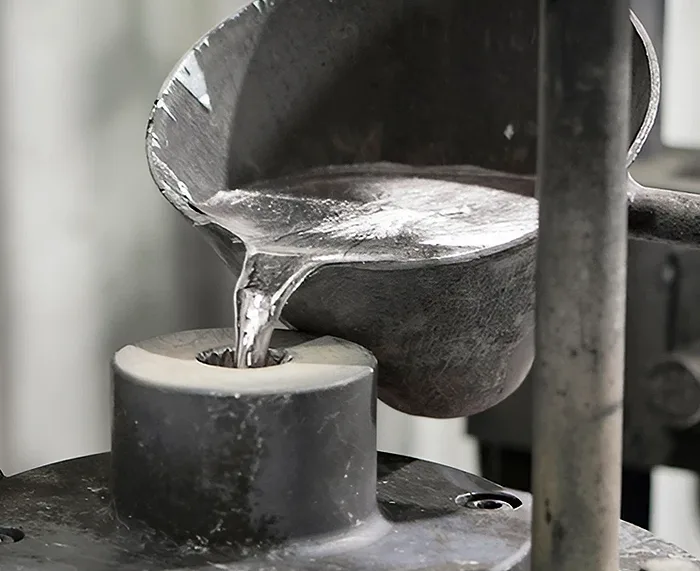
Gravity casting, also known as gravity Die Casting or permanent mold casting, is a casting process used to produce
high-quality metal parts with excellent dimensional accuracy and surface finish.
It is a popular method for manufacturing complex shapes and intricate designs.
Gravity Casting Offers Several Advantages:
Dimensional Accuracy
Gravity casting produces parts with tight tolerances and excellent dimensional
accuracy due to minimal shrinkage during solidification.
Surface Finish
The process yields parts with smooth surfaces that often require minimal post-casting finishing operations.
Material Flexibility
Gravity casting can be used with various non-ferrous metals like aluminum, zinc, copper alloys, etc.,
allowing for versatility in material selection based on specific requirements.
Cost-effective
Compared to other methods like Sand Casting or Investment Casting, gravity casting can be more cost-effective
for producing medium to high-volume production runs due to shorter cycle times and reduced labor costs.
What Is The Process Of Gravity Casting?
Understand the customer's needs
The procedure should start with understanding the customer’s needs, such as the application of the cast,
the choice of alloys, size, shape, wall thickness, technical properties
(e.g.,tensile strength,yield strength, and elongation), structure, and weight.
Design Of The Cast And "Pattern" Making
This is important for Industrial Parts, which need precise calculation to make sure that pieces could fit and work together.
Currently, the pattern making is assisted by computer simulation so that high precision can be achieved.
Then the pattern is moulded into a three-dimensional shape so that the accuracy of the core could be measured before the final casting.
Wood, clay or plastic is often used here. Due to the development of technology, now this can be done through 3D-printing.
Creation of a mould
Based on the confirmed pattern, a mould is created. In the case of gravity casting, reusable metal moulds are created for the desired pattern.
Melting and pouring of metal or alloys
Metal is melted and then the molten metal is poured into the mould under gravity. Traditionally, this is done by hand.
Thanks to modern technology, this pouring process is automatised and the productivity is tremendously improved.
Fettling
The cast object is removed from the mould and then fettled. During this process, any moulding materials on the model
are removed and rough edges and surfaces are smoothed. The cast object might need to be further processed.
Conclusion
saivs has the experience, technical expertise and quality assurance processes to consistently and reliably deliver
an extensive range of precision castings with further processing.
Why Choose SAIVS™ as Your Supplier?
1.Superb Quality Control Management
At SAIVS, we take pride in our perfect quality management systems and procedures, which guarantees the excellent performance of all our producs, being a professional Investment Casting | Die Casting| Sand Castingmanufacturer in China.
2.Rich Production Experience
With 20 years of experience in production, SAIVS has a deep understanding of the market and trends, and strives for continuous research and innovation. This has created advantages in both the product's performance and appearance.
3.Competitive Prices
As a Chinese factory committed to becoming the most cost-effective Investment Casting | Die Casting| Sand Castingexporter in China, SAIVS provides high-quality products at advantageous prices. By lowering costs and increasing efficiency, we ensure that our customers receive the best possible value for their investment.
4.Perfect After-sales Service
At SAIVS, we strive to provide superior customer service that meets and exceeds expectations. We are always available for any questions or concerns you may have, and we stand by our commitment to providing excellent after-sales support.
Related Posts
-
Powder Coating: A Durable and Sustainable Finishing Solution
Powder coating offers a superior alternative to traditional liquid coatings. Learn about the process, composition, and FAQs about powder coating.
-
Optimized Heat Treatment Process for Special Aluminum Alloy Shaft Sleeves
Optimized Heat Treatment Process for Special Aluminum Alloy Shaft SleevesThe shaft sleeve is a key functional component in gear pump systems.It is installe
-
How Casting Simulation Improves Metal Casting Quality
Casting is a manufacturing process in which molten metal is poured into a mold and allowed to solidify. It is a versatile process that can be used to produ
-
The 6-Step Process of Sand Casting: A Step-by-Step Guide to Creating Metal Castings
This comprehensive guide delves into the 6-step process, from pattern making and mold preparation to melting, pouring, and finishing.
-
The Advantages of CNC Machined Parts Over Molded Parts
CNC machining offers numerous advantages over molding. Discover why machined parts are the preferred choice for rapid prototyping and small-batch production in ...
-
Optimizing Tool Materials for Efficient Cast Iron Machining
In the competitive landscape of the machinery industry, improving processing technology and increasing efficiency are crucial for reducing overall costs. O



