
Advanced Temperature Measurement and Control in Precision Casting
Author: SAIVS Date Published: Mar 30,2026
Advanced Temperature Measurement and Control in precision casting
Precision casting manufacturers understand that stable process control determines final product quality.
Among all process variables, metal temperature plays the most critical role.
Accurate temperature monitoring directly influences casting integrity, mechanical properties, and dimensional accuracy.
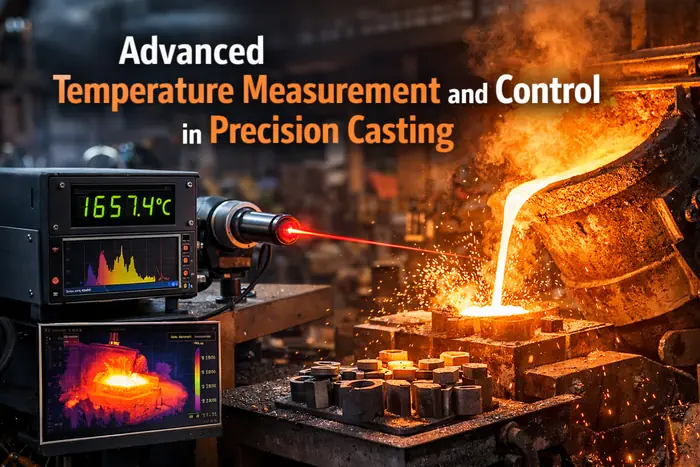
Why Metal Temperature Control Is Critical
In precision casting, especially during directional or equiaxed solidification, temperature variation impacts multiple quality factors.
Even slight deviations can lead to defects such as porosity, grain inconsistency, and hot tearing.
Thin-wall filling performance is also highly sensitive to temperature fluctuations.
Improved temperature control enhances product consistency, reduces scrap rates, and lowers operational costs.
Challenges in Non-Contact Temperature Measurement
Most foundries rely on non-contact infrared pyrometers for molten metal measurement.
However, real-world environments introduce significant sources of error.
Key Measurement Difficulties
Unknown emissivity is one of the biggest challenges.
Different alloy compositions and surface conditions cause emissivity variations that affect accuracy.
Steam, gas emissions, and molten pool disturbances can distort thermal radiation signals.
Dirty observation windows or unsuitable glass materials further reduce measurement reliability.
Instrument calibration drift and optical misalignment also introduce hidden errors.
Process-Related Limitations
Temperature in casting processes is not constant.
It fluctuates within a range, making precise control more complex.
Poor melting techniques can cause boiling, splashing, or chemical reactions.
Improper matching of crucibles, coils, and materials results in uneven heating and localized overheating.
Limitations of Conventional Pyrometers
Traditional pyrometers depend heavily on fixed emissivity settings.
This assumption rarely holds true in real casting conditions.
Small compositional changes in alloys can lead to temperature errors of several hundred degrees.
These inaccuracies can disrupt production cycles, increase energy consumption, and damage refractory materials.
High-Temperature Spectrometer Technology
Modern multi-wavelength pyrospectrometers solve many of these challenges.
They eliminate the need for predefined emissivity values.
This allows accurate temperature measurement regardless of material variations or environmental conditions.
Key Advantages
Real-time temperature and emissivity monitoring improves process transparency.
Signal strength analysis helps identify disturbances and abnormal conditions.
Continuous measurement ensures stable control without consumables or frequent maintenance.
These capabilities allow operators to detect alloy boiling, evaporation, and phase transitions.
Such insights are essential for maintaining alloy composition and casting quality.
Impact on Production Efficiency
Accurate temperature feedback prevents unnecessary power fluctuations.
It avoids repeated heating cycles caused by incorrect readings.
This reduces energy waste and shortens production time.
Stable control also minimizes electromagnetic disturbances.
As a result, refractory wear is reduced and product contamination is prevented.
Conclusion
Temperature measurement remains one of the most complex aspects of precision casting.
Conventional methods are no longer sufficient for high-precision requirements.
Advanced spectrometer-based solutions provide accurate, stable, and real-time data.
For manufacturers aiming to improve casting quality and reduce operational costs, upgrading temperature measurement systems is a necessary step.
Implementing reliable monitoring technology ensures consistent production and strengthens competitiveness in the global market.
Get Professional Support
If you are facing challenges in temperature control or Casting Defects, professional solutions are available.
Contact our technical team for Customized measurement systems and precision casting support.
Submit your inquiry today to improve efficiency and achieve higher product quality.
Why Choose SAIVS™ as Your Supplier?
1.Superb Quality Control Management
At SAIVS, we take pride in our perfect quality management systems and procedures, which guarantees the excellent performance of all our producs, being a professional Investment Casting | Die Casting| Sand Castingmanufacturer in China.
2.Rich Production Experience
With 20 years of experience in production, SAIVS has a deep understanding of the market and trends, and strives for continuous research and innovation. This has created advantages in both the product's performance and appearance.
3.Competitive Prices
As a Chinese factory committed to becoming the most cost-effective Investment Casting | Die Casting| Sand Castingexporter in China, SAIVS provides high-quality products at advantageous prices. By lowering costs and increasing efficiency, we ensure that our customers receive the best possible value for their investment.
4.Perfect After-sales Service
At SAIVS, we strive to provide superior customer service that meets and exceeds expectations. We are always available for any questions or concerns you may have, and we stand by our commitment to providing excellent after-sales support.
Related Posts
-
How can riserless casting be achieved in nodular iron production?
Achieving Riser-Free Casting in Nodular Cast Iron: Key Conditions and TechniquesNodular cast iron, also known as ductile iron, is a material highly valued
-
Causes and solutions of deformation of aluminum alloy die castings
Aluminum alloy die casting is widely used in various industries due to its excellent characteristics such as light weight, high strength, and good corrosion res...
-
Forging vs. Machining: A Comprehensive Comparison
Forging and machining are two fundamental industrial processes that shape and manufacture metal parts. Each process has advantages and disadvantages, makin
-
Exploring Die-Cast Prototyping Methods: Six Effective Strategies
Die casting is a manufacturing process used to create metal parts with high precision and excellent surface finish.When it comes to prototyping for die-cas
-
Design Considerations for Aluminum Die Casting
Aluminum die casting is a widely used manufacturing process for producing complex, high-precision parts. Manufacturers achieve excellent dimensional accura
-
How Casting Simulation Improves Metal Casting Quality
Casting is a manufacturing process in which molten metal is poured into a mold and allowed to solidify. It is a versatile process that can be used to produ



