
Steel Casting Heat Treatment Processes: Optimizing Mechanical Integrity
Author: SAIVS Date Published: Mar 23,2026
Optimizing Mechanical Integrity: Essential Heat Treatment Protocols for Steel Castings
The transition from a raw as-cast state to a high-performance industrial component depends entirely on controlled thermal processing.
Raw steel castings inherently possess dendritic segregation and uneven grain structures that compromise structural reliability.
Implementing rigorous heat treatment eliminates internal residual stresses and refines the Widmanstätten structure often found in alloy steels.
Our commitment to precision ensures that every casting meets the exact mechanical specifications required for heavy-duty industrial service.
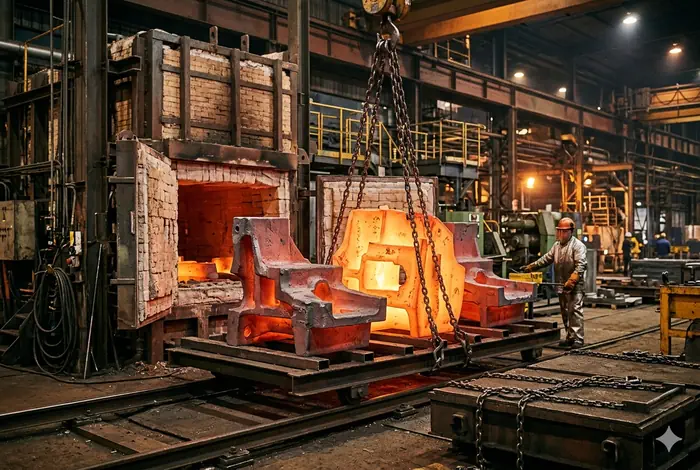
Core Characteristics of the Steel Casting Thermal Cycle
Steel castings demand a more aggressive thermal approach compared to forged counterparts.
Due to the presence of coarse dendrites, austenitization temperatures must be set approximately 20°C higher than standard Forging benchmarks.
Extended holding times are mandatory to achieve chemical homogenization across varying wall thicknesses.
Complex geometries require strategic stacking in the furnace to prevent thermal deformation and ensure uniform airflow.
Consult with our metallurgy team to determine the optimal thermal parameters for your specific alloy grade.
1. Precision Heating and Thermal Ramp Control
Heating efficiency dictates both the cost-effectiveness and the final quality of the cast component.
Controlled Heating Rates for Complex Geometries
Rapid heating maximizes furnace throughput and minimizes surface decarburization in standard sections.
However, castings with drastic changes in wall thickness require a phased approach to manage thermal stress.
We utilize a two-stage heating process for sensitive components, incorporating a soak period below 600°C.
This method prevents cracking and ensures the core and surface reach equilibrium without structural compromise.
Advanced Heating Methods
Our facility utilizes radiation and induction heating techniques tailored to the chemical composition of your project.
Each loading configuration is engineered to utilize the effective furnace space while guaranteeing unobstructed heat transfer.
2. Critical Holding Temperatures and Phase Transformation
The holding stage is where the fundamental homogenization of the steel microstructure occurs.
For hypoeutectoid steels, maintaining temperatures 30-50°C above the Ac3 point is vital for complete carbide dissolution.
Precise temperature regulation prevents excessive grain growth in sensitive grades like manganese steel.
Determining Optimal Soak Time
Holding duration is a direct function of the casting’s maximum wall thickness and thermal conductivity.
A standard rule of 30 to 60 minutes per 25mm of section thickness ensures total transformation.
Alloyed castings necessitate longer durations to allow slow-diffusing elements to reach equilibrium.
This attention to detail results in a uniform hardness profile across the entire cross-section of the part.
3. Cooling Strategies and Stress Management
The final cooling rate determines the resulting metallographic structure and final tensile strength.
Accelerated cooling refines the grain size but increases the risk of residual internal stress.
Our engineers select the cooling medium—be it air, oil, or water—based on the specific hardenability of the alloy.
For low-alloy steels prone to temper brittleness, we employ rapid cooling through the sensitive temperature zones.
This technical precision prevents toughness degradation and ensures the longevity of the component in the field.
Post-Treatment Quality Assurance
Every batch undergoes rigorous verification to confirm that the heat treatment has achieved the desired phase transformation.
We provide full documentation of furnace charts and metallurgical reports for your Quality Control records.
Secure Your Supply Chain with Certified Heat Treatment Expertise
The performance of your machinery relies on the internal grain structure of its cast components.
Substandard thermal processing leads to premature field failure and increased maintenance costs.
Partner with a manufacturer that prioritizes metallurgical science and repeatable process control.
Submit your technical drawings today for a comprehensive quote and consultation on your steel casting requirements.
Our technical sales department is available to discuss specific alloy performance and delivery schedules for your next project.
Why Choose SAIVS™ as Your Supplier?
1.Superb Quality Control Management
At SAIVS, we take pride in our perfect quality management systems and procedures, which guarantees the excellent performance of all our producs, being a professional Investment Casting | Die Casting| Sand Castingmanufacturer in China.
2.Rich Production Experience
With 20 years of experience in production, SAIVS has a deep understanding of the market and trends, and strives for continuous research and innovation. This has created advantages in both the product's performance and appearance.
3.Competitive Prices
As a Chinese factory committed to becoming the most cost-effective Investment Casting | Die Casting| Sand Castingexporter in China, SAIVS provides high-quality products at advantageous prices. By lowering costs and increasing efficiency, we ensure that our customers receive the best possible value for their investment.
4.Perfect After-sales Service
At SAIVS, we strive to provide superior customer service that meets and exceeds expectations. We are always available for any questions or concerns you may have, and we stand by our commitment to providing excellent after-sales support.
Related Posts
-
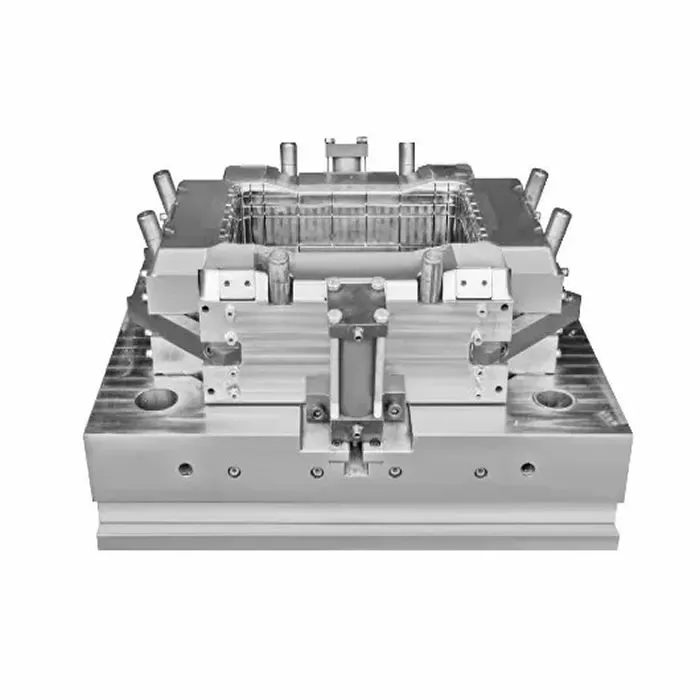
Common problems, causes and solutions of die casting mould
1. Ejector Pin IssuesCommon Issues:Ejector pin jams or breaksPointed position of the ejector pinMaterial build-up at the ejector pin siteDeep or excessive
-
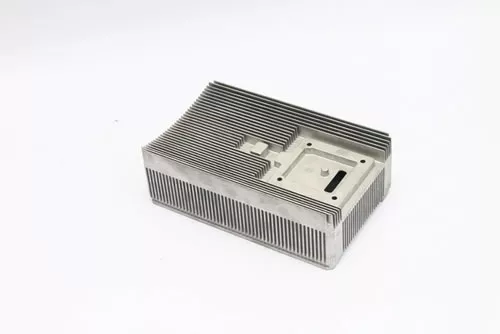
Die Casting Die for Automotive
I hope it will be helpful to you for the manufacturing process and technical requirements of automobile die casting dies.Automotive industry is one of the most ...
-
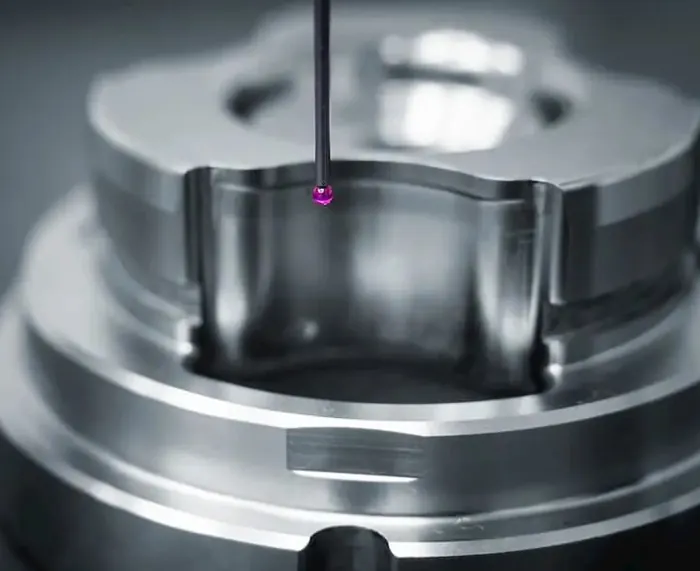
CNC Machining Tolerance Guidelines
IntroductionCNC machining is a precise manufacturing process that involves the use of computer-controlledmachines to create intricate parts and components. One ...
-
What are the requirements for precision die casting?
Precision Die Casting: A Superior Metal Forming TechnologyPrecision die casting is a cutting-edge manufacturing process that allows for the creation of int
-
Sand Casting Using 3D Printing Technology
Sand casting has been a widely used method for manufacturing complex metal parts for centuries.However, with the advent of 3D printing technology, sand casting ...
-
Achieving Consistent Color in Injection Molding
This article explores the importance of color consistency in injection molding and details various methods and best practices to achieve it.



