
X-ray detection of internal defects in die castings
Author: SAIVS Date Published: Jun 06,2023
aluminum castings are widely used in industries such as automotive parts, mechanical manufacturing, computers, electronics, medical equipment, watch instruments, hardware products, aerospace, etc. Mainly because Aluminum Castings have a smooth surface, high practicality, and precise dimensions. The general casting production process mainly includes: material selection - melting - low-pressure casting - X-ray inspection - cleaning, Sandblasting, deburring - heat treatment - mechanical processing - surface treatment. However, the finished castings often have too many defects. Casting is one of the basic processes in modern mechanical manufacturing industry, which has the advantages of low cost, one-time forming, and the ability to manufacture complex structural large parts. It is widely used in automotive parts, mechanical manufacturing, electronics Numerous fields of industrial production such as medical equipment, clock instruments, hardware products, aerospace, etc.
Casting, as an important fundamental industry in the mechanical industry, with the rapid development of information technology, improving the production efficiency and quality of casting will be a necessary task for many casting workers. The high scrap rate of castings has always been a common problem in various casting methods in the industry. It is particularly important to better control the quality of castings and improve casting processes.
Due to the complexity of the casting process, there are many factors that affect the quality of castings. Poor control of raw materials, unreasonable process plans, unreasonable design of mold structures, and improper production operations can all lead to various defects in castings. Common defects include inclusions, bubbles/pores, porosity, and cracks.
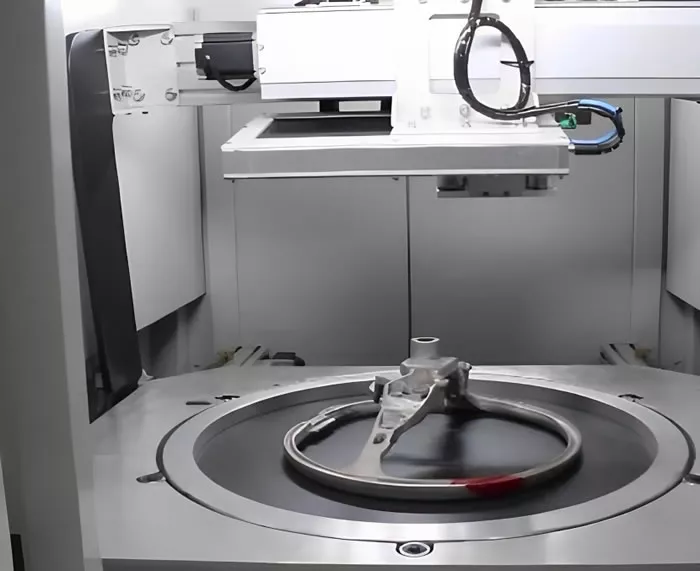
Common defect factors:
1. Cracks
Mainly caused by unreasonable structural design and substandard manufacturing processes, the cracks mainly come in two forms: casting cracks and heat treatment cracks. The cracks appear as light colored lines in the X-ray inspection image.
2. Bubbles/pores
This is mainly caused by poor ventilation during the casting process, as well as the doping of air or impurities. The bubbles/pores on the surface of the workpiece can be detected by sandblasting, and the bubbles/pores inside the workpiece can be detected by X-ray fluoroscopy.
3. Looseness
Mainly caused by unreasonable design structure, casting porosity generally occurs at the thick and thin junction of the wall near the inner runner, the thicker part of the flying riser root, and the thin-walled part with a large plane. X-ray fluoroscopy can reveal this defect, which is severely filamentous in X-ray images and generally appears as a light colored cloud.
4. Inclusions
Mainly caused by unclean furnace materials or improper operation of slag inclusion, mainly distributed on the upper surface of Aluminum castings and at the corners of the mold where there is no ventilation. X-ray fluoroscopy can reveal this defect, which appears deep in the X-ray image
Why Choose SAIVS™ as Your Supplier?
1.Superb Quality Control Management
At SAIVS, we take pride in our perfect quality management systems and procedures, which guarantees the excellent performance of all our producs, being a professional Investment Casting | Die Casting| Sand Castingmanufacturer in China.
2.Rich Production Experience
With 20 years of experience in production, SAIVS has a deep understanding of the market and trends, and strives for continuous research and innovation. This has created advantages in both the product's performance and appearance.
3.Competitive Prices
As a Chinese factory committed to becoming the most cost-effective Investment Casting | Die Casting| Sand Castingexporter in China, SAIVS provides high-quality products at advantageous prices. By lowering costs and increasing efficiency, we ensure that our customers receive the best possible value for their investment.
4.Perfect After-sales Service
At SAIVS, we strive to provide superior customer service that meets and exceeds expectations. We are always available for any questions or concerns you may have, and we stand by our commitment to providing excellent after-sales support.
Related Posts
-
Die Casting vs Stamping: A Practical Guide to Choosing the Best Metal Forming Method for Your Parts
Die Casting vs Stamping — Practical Differences Every Buyer Should KnowDie casting and stamping are both mass-production metal forming methods but they ser
-

The Timeless Technique of Sand Casting: Past, Present, and Future
This article delves into the fundamentals of sand casting, its historical significance, technological advancements, material applications, and its future in hig...
-

Surface and Internal Quality Inspection Methods for Castings in Industrial Manufacturing
Introduction to Casting Quality InspectionIn modern industrial manufacturing, the quality of castings directly affects product safety, service life, and ov
-
What are the requirements of aluminum alloy die casting for the function of die steel?
1. High tempering resistance and cold and hot fatigue resistance of aluminum alloy die-castingMany aluminum alloy die-casting dies produced continuously should ...
-
Unlocking Diversity: 3 Types of Sand Molds Commonly Used in Sand Casting
Learn about the 3 main sand molds used in sand casting.
-
Advanced Strategies to Extend the Life of Aluminum-Magnesium Die-Casting Molds — SAIVS Best Practice
How SAIVS Improves the Service Life of Aluminum-Magnesium Die-Casting MoldsAluminum-magnesium die-casting molds operate in extremely aggressive thermal and



