
How to Realize Quenching and Cooling with Water Instead of Oil
Author: SAIVS Date Published: Jun 16,2026
quenching oil has been the dominant cooling medium in heat treatment for decades.
It offers unique cooling characteristics, but carries significant drawbacks in energy consumption, environmental pollution, and fire safety.
Replacing oil with water as a quenchant solves these problems, yet introduces technical challenges.
This article presents a systematic approach to water-based quenching that maintains metallurgical quality while eliminating oil-related risks.
1. The Limitations of Quenching Oil in Modern Heat Treatment
Mineral oil consumed in quenching represents a substantial petroleum resource drain.
In 2010, China's heat treatment industry used over 120,000 tons of mineral oil, equivalent to 210,000 tons of standard coal, or nearly 5.2 billion kWh of electricity.
Most of this oil converts to oil fume – over 80 million cubic meters annually – releasing carbon monoxide and sulfur dioxide.
These emissions rank as the primary pollution source in heat treatment shops.
Furthermore, the majority of fire accidents in this industry originate from quenching oil.
Oil also provides limited cooling capacity, making it unsuitable for low-carbon steel workpieces that require faster quenching rates.
Oil quenching is costly, polluting, hazardous, and restrictive – a clear case for replacement.
2. Why Water Quenching Presents Technical Difficulties
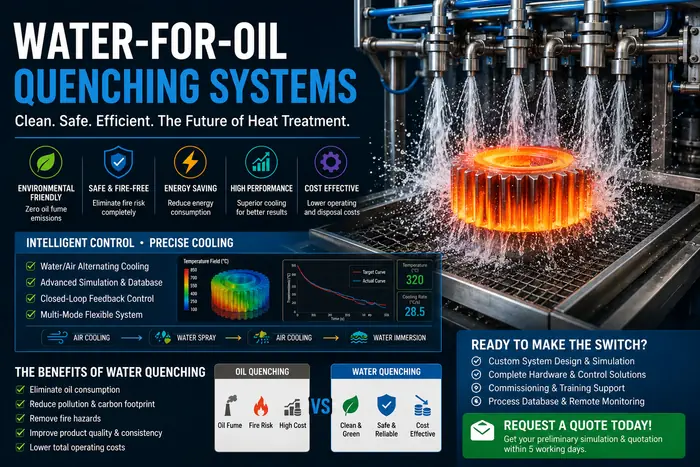
Water offers abundant cooling capacity and zero fire risk, but its cooling behavior differs from oil in two critical aspects.
First, water exhibits an excessively long film boiling stage, delaying the boiling curve past the nose tip of most steel CCT diagrams.
This long film boiling period prevents the required rapid cooling through the pearlite and bainite transformation zones.
Second, the low-temperature cooling rate in water is too fast, generating high thermal stress and transformation stress.
This rapid bottom cooling increases the risk of distortion and cracking in the workpiece.
The intrinsic cooling characteristics of water cannot be changed, but the contact timing and method between workpiece and water can be controlled.
Overcoming these two hurdles is the core challenge of water-for-oil quenching.
3. Practical Approaches – Water/Air Alternating Cooling
Industrial practice shows that alternating water and air cooling is a viable path.
By interrupting water spray or immersion with air cooling periods, the effective cooling curve can be shaped to avoid the C-curve nose while reducing low-temperature stress.
However, empirical process trials alone carry high risk of scrap and high cost.
Blind experimentation with different water pressures, spray patterns, and timing sequences often leads to cracked parts.
Therefore, numerical simulation must precede physical trial runs for water-based quenching.
4. Prerequisites for Successful Water-for-Oil Quenching Systems
4.1 Versatile Cooling System Hardware
The quenching system must support multiple cooling modes: air cooling, mist cooling, water spraying, water immersion, and combinations or alternations thereof.
This requires multiple injection units with dedicated media channels for air and water.
Fast-response electric or pneumatic valves must enable rapid filling and emptying of the quenching tank.
Changeover between modes must occur within seconds to follow the designed cooling profile.
Hardware flexibility is the foundation of precise quench control.
4.2 Cooling Capacity Database and Process Simulation
Build a comprehensive database of water cooling capacities under various conditions – different pressures, flow rates, nozzle types, and workpiece geometries.
Use heat treatment simulation software (e.g., DANTE, SYSWELD, or DEFORM) to calculate temperature fields, phase transformation fields, and stress fields.
These simulations couple thermal, metallurgical, and mechanical phenomena during quenching.
Through virtual iteration, determine the optimal cooling sequence without risking actual parts.
Simulation reduces process development time and eliminates costly trial-and-error waste.
4.2.1 Validation through Limited Physical Tests
After simulation, run a small number of physical tests on representative workpieces to confirm the predicted results.
Measure hardness profiles, distortion values, and residual stresses to calibrate the simulation model.
Once validated, the simulation can be reused for similar workpiece families.
Simulation plus targeted validation is the most efficient development route.
4.3 Intelligent Closed-Loop Control System
The quenching system must be fully automated with programmable logic control (PLC) or industrial PC control.
Set and execute key parameters: flow pattern (spray, mist, jet, immersion), flow rate, pressure, temperature, and timing for each medium.
Closed-loop feedback using thermocouples or pyrometers adjusts parameters in real time to maintain the prescribed cooling curve.
Response accuracy must reach second-level precision to avoid overshooting or undershooting the target cooling rate.
The control range shall cover the entire spectrum from slow air cooling to near-brine rapid cooling.
Intelligent control enables one system to handle diverse workpiece grades and sizes.
5. Implementation Roadmap for Water-Based Quenching
Start with a feasibility study using simulation for a specific workpiece material and geometry.
Then design the hardware – pumps, nozzles, valves, and tank layout – based on required cooling intensity ranges.
Install and commission the control system with pre-set recipes for each workpiece type.
Perform pilot runs and compare simulated versus actual results; fine-tune the control logic.
Once stable, scale up to full production and document all process parameters.
This structured method ensures successful transition from oil to water quenching.
6. Benefits of Water-for-Oil Quenching Systems
Eliminate mineral oil consumption – save energy and reduce carbon footprint.
Cut oil fume emissions to near zero, meeting stringent environmental regulations.
Remove fire hazards – water is inherently non-flammable and safe to use.
Improve cooling capacity for low-carbon and alloy steels that oil cannot harden adequately.
Reduce overall operating costs due to cheaper coolant and lower waste disposal fees.
Water quenching is the sustainable future for heat treatment.
7. How to Get Started – Request a System Design and Quotation
Axion provides complete engineering solutions for water-based quenching systems.
We supply the full hardware package: pumps, valves, nozzles, tanks, and control cabinets.
Our simulation team works with your material data to generate a custom cooling process.
We also deliver commissioning support and operator training on site.
Each system comes with a process database and remote monitoring capability.
Submit your workpiece specifications (material grade, size, hardness requirement) through the inquiry form below.
Our engineers will reply with a preliminary simulation result and a budget quotation within 5 working days.
Fill in the form now – move your heat treatment to cleaner, safer water quenching.
Why Choose SAIVS™ as Your Supplier?
1.Superb Quality Control Management
At SAIVS, we take pride in our perfect quality management systems and procedures, which guarantees the excellent performance of all our producs, being a professional Investment Casting | Die Casting| Sand Castingmanufacturer in China.
2.Rich Production Experience
With 20 years of experience in production, SAIVS has a deep understanding of the market and trends, and strives for continuous research and innovation. This has created advantages in both the product's performance and appearance.
3.Competitive Prices
As a Chinese factory committed to becoming the most cost-effective Investment Casting | Die Casting| Sand Castingexporter in China, SAIVS provides high-quality products at advantageous prices. By lowering costs and increasing efficiency, we ensure that our customers receive the best possible value for their investment.
4.Perfect After-sales Service
At SAIVS, we strive to provide superior customer service that meets and exceeds expectations. We are always available for any questions or concerns you may have, and we stand by our commitment to providing excellent after-sales support.
Related Posts
-
How To Calculate Pressure Die Casting Tonnage
Calculation FormulaThe calculation formula for the selection of die-casting machine: Die-casting machine clamping force (t) = 1.4 * casting projected area
-
Understanding 3D Printing Technologies and Inspection Methods
This article explores seven main categories of 3D printing and the inspection methods used to guarantee the quality and reliability of printed parts.
-
Optimize Mold Machining with the Right Tools and Process Planning
Boost mold manufacturing productivity and tool life with the right machining strategies, tooling choices, and process planning.
-
Choosing a Stainless Steel Foundry: Key Factors to Consider
Stainless steel casting is a manufacturing process that involves pouring molten stainlesssteel into a mold to create a desired shape or component. It is a versa...
-
Advanced Heat Treatment Strategies for 700°C A-USC Superalloys — SAIVS Solutions
Advanced Heat Treatment Strategies for 700C A-USC Superalloys — SAIVS SolutionsSummary:This article reviews recent research trends in the heat treatment of
-
How To Choose The Right Casting Cleaning Equipment
Key Considerations for Selecting the Right Shot Blasting Equipment in FoundriesCasting cleaning is an essential process in any foundry, ensuring that casti



